

The scale of global wealth migration in 2025 was unprecedented. According to Henley & Partners’ Private Wealth Migration Report, 142,000 high-net-worth individuals, typically defined as individuals with investable assets over $1 million, relocated internationally during the year, the highest figure ever recorded. High-net-worth relocation trends for 2026 put that number at 165,000, suggesting this trend is structural rather than cyclical.
For the first time, private wealth migration has moved from a niche planning tool to a defining feature of how globally mobile families manage their financial lives. The question for affluent individuals today is not whether to consider jurisdictional diversification; it is where, when, and how.
2025-2026 at a Glance: Record Wealth Migration and Emerging Caribbean Hubs
The 2025 data tells a clear story of redistribution.
- The UK lost a record number of 16,500 millionaires, the largest national net outflow ever recorded
- China shed 7,800 high-net-worth individuals
- India lost 3,500
- South Korea lost 2,400.
As 2026 global mobility projections surpass even those figures, it is clear that this is not a temporary correction but a lasting reshaping of where private capital resides.
The Caribbean, and The Bahamas in particular, sits within an expanding tier of destinations capturing meaningful flows from this migration, particularly among North American, British, and European buyers for whom proximity, lifestyle, and legal/tax structure converge in a single location.
What Is Driving High-Net-Worth Relocation Trends Today?
Three forces are converging to drive the great wealth migration at scale, shaped by a complex mix of tax policy, political stability, and lifestyle factors. First, the UK’s non-dom abolition, European wealth tax discussions, and the growing reality of exit tax mechanisms have made the cost of staying put in high-tax jurisdictions increasingly concrete. Second, affluent families want their assets and residence in stable, rule-of-law jurisdictions. Third, wealthy individuals consistently migrate toward destinations with robust infrastructure and excellent international healthcare.
What unites these moves is not simply tax, but optionality with investment migration serving as one element in broader competitive strategies for attracting and retaining global wealth. Ultra high-net-worth families are treating jurisdictional residency as a diversified portfolio to mitigate risk, in the same way they diversify investments. UBS’s 2025 Billionaire Ambitions Report found that 36% of billionaires surveyed had already relocated, nearly half of those under 55 changed their country of residence during the year, 9% of billionaires are considering relocating in 2026, and 61% of family offices consider geopolitical conflict a primary risk. Lastly, applications for foreign residency programs among US nationals rose by nearly 30% over the same period. Favorable tax structures and flexible residency programs are primary catalysts for migration.
Tax Changes Reshaping Wealth Migration: UK Non-Dom Abolition, Wealth Taxes, and Exit Tax Concerns
Of all the policy changes driving wealth migration, the UK’s tax regime overhaul is the most significant in scale and consequence. From April 2025, the UK moved to a fully residence-based tax model, removing a long-standing planning assumption for HNWIs who had structured their affairs around the non-dom rules for decades. The net outflow of 16,500 from the UK in 2025 is its most visible result.
Beyond the UK, wealth taxes across Spain, Norway, and parts of Switzerland have demonstrated how fiscal unpredictability accelerates relocation decisions among the most mobile segment of the wealth spectrum. Affluent families are now monitoring inheritance rules, gift taxes, and regional surcharges alongside income and capital gains, and making residency decisions accordingly. Exit tax anxiety compounds the picture further: Canada’s deemed-disposition model at departure is well established, and other major economies are reviewing similar mechanisms. For wealthy individuals, the question is not only what applies today, but it is also what may apply in five years, and whether their current jurisdiction offers the predictability long-term planning requires.

The Rise of Crypto Wealth Migration
A growing and often underreported segment of global wealth’s continued outflows involves individuals who accumulated significant wealth through cryptocurrency and are now seeking to convert digital assets into hard, income-generating real estate in zero or low-tax jurisdictions.
Bitcoin’s sustained price appreciation has created a generation of crypto-native high-net-worth individuals, many holding substantial BTC or USDT positions and actively looking to diversify into tangible assets. For this segment, the intersection of capital gains exposure, offshore real estate, and jurisdictional flexibility is a particularly urgent planning question.
The Bahamas, as a zero capital gains jurisdiction, is particularly well-positioned: any appreciation on a Bahamian real estate asset is untaxed, making the conversion of digital wealth into property a structurally compelling move for buyers who have already accumulated significant gains. Aqualina Bahamas is one of the only luxury developments in the Caribbean currently accepting Bitcoin and Tether (USDT) as payment under progressive Bahamian regulations, offering a direct, compliant pathway for crypto-native buyers to establish a Caribbean residence without liquidating through traditional financial channels.
The Bahamas: A Tax-Efficient, Lifestyle-Driven Destination for Private Wealth
Few zero-tax jurisdictions combine fiscal efficiency, lifestyle quality, and proximity to the United States the way The Bahamas does. Just 35 minutes from Miami by air, it stands apart from every comparable destination in the world.
One element that sets the country apart is that it levies no income tax, capital gains tax, wealth tax, or inheritance tax on residents. The Bahamian dollar is pegged to the US dollar, eliminating currency risk for North American buyers. Furthermore, property ownership above qualifying thresholds opens a direct pathway to permanent residency. The British common law system, supported by a familiar regulatory framework, provides the legal transparency that international investors and their advisors require.
On the lifestyle side, the Bahamas offers a warm climate, world-class marinas, strong education options, and an abundance of private international banking providers, without the language barriers, currency risk, or complexity that more remote jurisdictions carry. For wealthy families with business, personal, or generational ties to the US, the ease of maintaining business opportunities across both markets is often the deciding factor.
Permanent Residency in The Bahamas Through Property Ownership
Economic Permanent Residency in The Bahamas is available for qualifying investors who purchase a US$1 million home, with expedited consideration for investments of US$1.5 million or more. The process involves purchase completion, source-of-funds documentation, and submission to the Bahamian Department of Immigration for the applicant and qualifying dependents. Buyers should confirm current thresholds with qualified Bahamian legal counsel, as requirements are subject to review.
The Bahamas operates a legitimate, compliance-aligned residence pathway, not a passport-for-sale program. For new residents relocating from high-tax jurisdictions, the ability to acquire permanent residency directly through a property purchase is a material structural advantage: the residence, the lifestyle asset, and the tax repositioning are secured in a single transaction.
Why Nassau Is the Right Address Within The Bahamas
Nassau has matured well beyond a seasonal holiday destination. Lynden Pindling International Airport’s US pre-clearance facility makes travel between Nassau and the United States as seamless as a domestic connection. Private healthcare facilities, accredited education systems, breathtaking beaches, high-end dining, and the comprehensive hospitality ecosystem of Baha Mar now support full-time residence at a standard that meets the expectations of globally mobile buyers.
Cable Beach and the West Bay area have become the most established addresses for luxury waterfront property in Nassau, where the infrastructure, hospitality ecosystem, and quality of life reflect a city that has grown into a serious global destination.
Aqualina Bahamas: Luxury Waterfront Living at the Centre of Nassau’s Growth
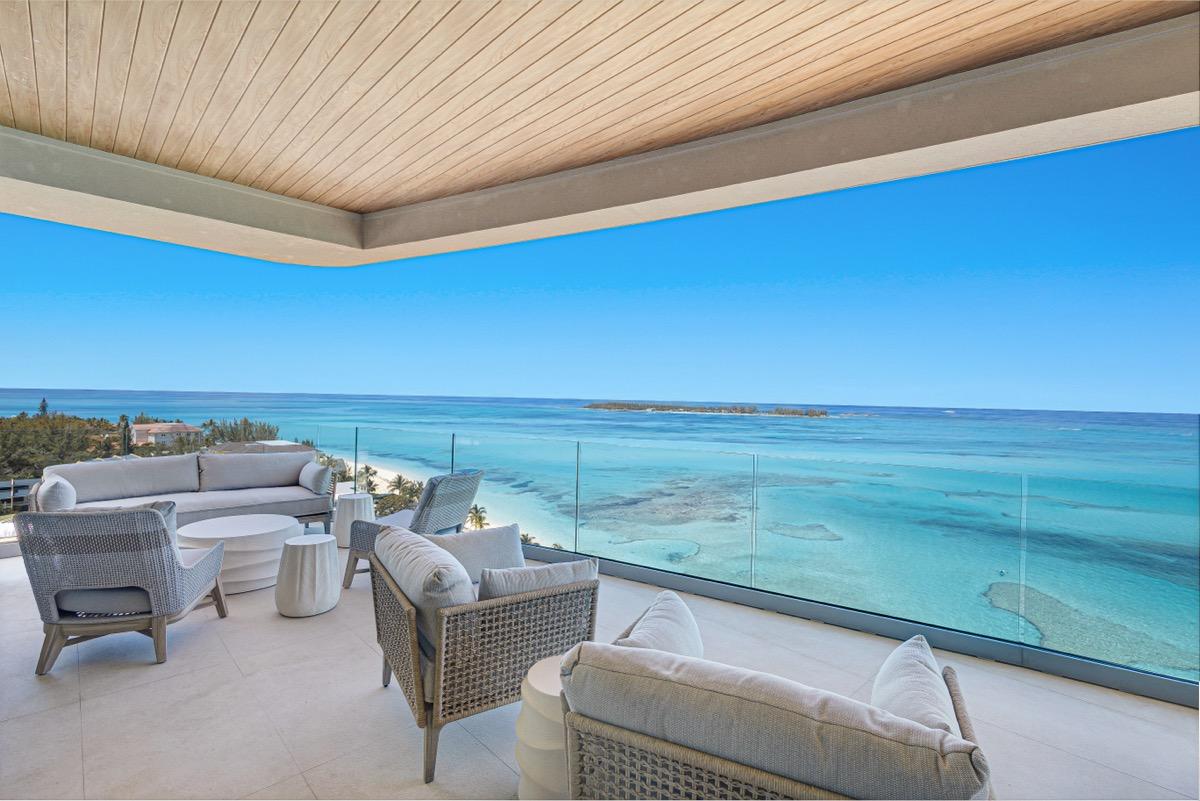
One development worth examining is Aqualina Bahamas, a luxury condominium residence located on Cable Beach developed by one of the country’s most recognized high-end developer, Aristo Development. Three and four-bedroom units offer ocean views, finished interiors, resort-style amenities, wellness facilities, and concierge services. Tower 1 is already completed and sold, and the second tower is under construction and will be completed in the summer of 2026. Ocean view prices start from $3,395,000 for a 3-bedroom, 2,577 sq ft unit, plus 623 sq ft verandah.
What stands out structurally is the managed rental program yielding 7.7% net annually, not gross, after all operating costs. For buyers who elect to spend much of the year elsewhere, the asset earns in their absence.
Key Considerations for High-Net-Worth Relocators
Any relocation of this nature requires coordinated advice across tax, legal, and financial planning in both the originating and destination jurisdiction, covering domicile, exit tax exposure, trust structures, and succession planning before a transaction completes. Buyers should expect thorough KYC, AML, and source-of-funds documentation throughout the process, and hiring an experienced Nassau-based lawyer may reduce friction and shorten timelines materially.
Outlook: The Future of High-Net-Worth Relocation and The Bahamas’ Role
Millionaire migration will continue reshaping where global wealth resides. With 165,000 HNWIs expected to relocate in 2026, the trajectory is clear. Tax efficiency alone no longer differentiates; every serious jurisdiction now competes on that basis. What will determine net inflows in the coming years is how effectively nations address a complex mix of tax, lifestyle, and political concerns.
The Bahamas sits at a compelling intersection of those same priorities. For wealthy families evaluating Nassau luxury real estate as part of a broader residency and wealth preservation strategy, developments such as Aqualina Bahamas offer a refined, operational base, already built, already earning, and positioned in a jurisdiction competing credibly with destinations across the Middle East, Europe, and the Caribbean for serious private capital.